 Skip to content
To order custom tents and event displays from MorningTents, begin with six essentials: the product type, required size, quantity, artwork status, delivery destination, and target arrival date. MorningTents can then help define the configuration, prepare a project-specific quotation, create or review the artwork proof, and confirm the production and shipping plan. Production should begin only after the commercial details, specifications, and final proof are approved in writing.
The process is straightforward when each decision is recorded. However, minimum order quantity, sampling, lead time, payment, and freight cannot be assumed from a general guide. These terms depend on the selected product, customization, order volume, destination, and current factory or logistics conditions. Buyers should obtain written confirmation for their specific project.
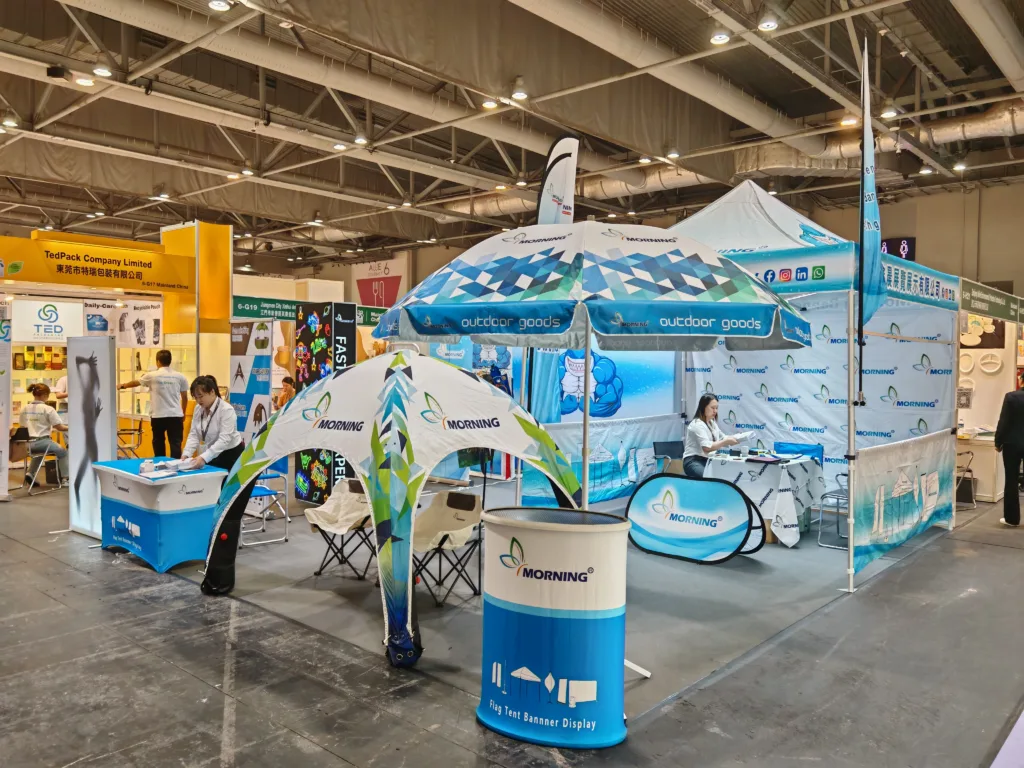
The MorningTents ordering process at a glance
The table below shows the main stages, the buyer’s input, and the result to approve before moving forward.
| Stage | Buyer provides or confirms | Expected result |
|---|---|---|
| 1. Project brief | Use, product, size, quantity, destination, arrival date | Defined inquiry scope |
| 2. Configuration | Structure, printed areas, accessories, packaging needs | Product configuration |
| 3. Quotation | Commercial and delivery requirements | Written itemized quote |
| 4. Artwork and sample | Logo files, text, colors, proof comments | Approved proof or sample plan |
| 5. Order confirmation | Final specifications, quantities, terms, payment | Production-ready order record |
| 6. Production and QC | Agreed inspection requirements | Finished and checked products |
| 7. Packing and shipping | Marks, destination, shipping scope, documents | Dispatch plan and shipment record |
| 8. Receipt and after-sales | Delivery inspection and supporting evidence | Closed order or documented claim |
The safest workflow uses approval gates. Do not allow an attractive mockup, a quotation, or a payment record to substitute for the complete approved order specification.
1. Define the event before choosing products
Start with the event objective rather than a product name. A street-market vendor, touring sports sponsor, trade show exhibitor, and distributor may all ask for a “custom tent,” but they need different structures, printed surfaces, accessories, and packing arrangements.
Include the following information in the initial inquiry:
- event type and whether the equipment will be used indoors or outdoors;
- installation frequency and expected handling conditions;
- available booth or site dimensions;
- required products and quantities;
- number of artwork versions;
- delivery country, city, and postal code;
- target arrival date rather than only the event date; and
- any required product documents, testing, labeling, or inspection.
Buyers can review MorningTents’ custom tents and portable shelters for canopy, gazebo, star, and kiosk options. The trade show display range includes products such as banners, flags, backdrops, and pop-up tables. When several items belong to one campaign, request them as one coordinated kit so artwork, quantities, packing, and destination labels can be managed together.
2. Confirm the exact product configuration
A complete configuration turns a broad inquiry into a quotable project. A canopy order may require decisions about size, frame, fabric, printed areas, sidewalls, bags, weights, and accessories. A display may instead require graphic dimensions, stand type, bases, lighting, or replacement graphics. Ask the sales team to separate included and optional components so apparently similar quotations can be compared correctly.
For each item, record:
- product model and finished dimensions;
- structure, material, or frame choice;
- printed and unprinted surfaces;
- required accessories and spare parts;
- quantity for each design version;
- units per kit or carton; and
- applicable documents or performance requirements.
If a performance characteristic matters, request confirmation for the exact model and material. Check the scope, test method, issuer, result, and validity of any supporting document rather than applying a general website claim to every product.
3. Request an itemized, project-specific quotation
The quotation should identify what is included, excluded, and still undecided. Connect each price to a model, design version, quantity, accessory set, and delivery scope.
Before accepting the quotation, review:
- product description and quantity breakdown;
- printing scope and number of artwork versions;
- design, proofing, or sample arrangements;
- accessories, spare parts, and packaging;
- unit price and any separate setup or service charges;
- payment schedule and currency;
- estimated production timing and what starts the clock;
- quotation validity and change conditions; and
- freight scope, destination, and applicable trade term.
MOQ, sampling, and lead time may vary by product, material, print setup, design version, and production method. Ask MorningTents to confirm them for the selected configuration.
For international orders, state the named place and trade rule. The International Chamber of Commerce explains that Incoterms® 2020 rules allocate certain delivery obligations, costs, and risks. They do not replace the sales contract, specification, or payment terms.
4. Prepare and approve the artwork
MorningTents states that its in-house graphic design team can prepare 2D and 3D proofs, while buyers who design internally can request templates. A proof should function as a production instruction, not merely as a visual preview.
Provide the approved logo, exact wording, brand color references, and any layout rules. Vector artwork is generally preferable when available because it supports clean scaling, but the supplier should confirm whether the submitted files are suitable for the selected printing process.
Review every proof for:
- project name, product model, revision number, and issue date;
- spelling, phone numbers, website addresses, and event dates;
- the correct logo and design version;
- dimensions and placement on each printed panel;
- orientation when the product is assembled and viewed;
- seams, folds, hardware, and safe areas;
- the relationship between adjacent panels; and
- the agreed method for evaluating color.
A screen proof can approve content and layout, but it does not prove fabric feel, structural function, or an exact color match. When these characteristics are critical, agree whether a swatch, decoration sample, or complete pre-production sample is needed. Sampling may change cost and schedule.

5. Lock the order before production
Production should start from one controlled order record. The quotation, purchase order or contract, approved proof, variant list, and written terms must agree. Verify the final product and accessories, design quantities, proof revision, color or sampling method, packing instructions, payment trigger, planned quality checks, and shipping responsibilities. Resolve every “TBD,” conditional, or approximate requirement. A conditional approval is not final; request and check the revised document.
6. Plan production, inspection, and evidence together
Different event products require different quality-control routes. A canopy, inflatable arch, backdrop, and pop-up counter do not share one universal checklist. MorningTents describes its production chain and printing capabilities on the company and factory page, but buyers should agree on checks for the exact order.
An order-specific inspection may cover:
- model, dimensions, and quantity;
- artwork version, placement, orientation, and visible text;
- frame, hardware, connectors, seams, or fasteners;
- assembly, inflation, opening, or another applicable function check;
- included accessories and spare parts;
- units per carton and shipping marks; and
- required documents or agreed inspection evidence.
Remote buyers can request overall photos, detail images, measurement photos, function videos, or packing records. Agree on this evidence before production. Factory photographs do not replace an independent inspection when the contract or risk level requires one.

7. Confirm packing, shipping, and the arrival plan
Work backward from the required arrival date, allowing time for artwork, sampling, production, inspection, packing, transport, customs, local delivery, receiving checks, and a trial setup.
MorningTents states that it offers worldwide shipping and different logistics options. The route depends on volume, carton dimensions, destination, urgency, and responsibilities. Confirm whether duties, taxes, customs clearance, unloading, or final-site delivery are included.
Before dispatch, confirm carton count, dimensions and weight; contents and accessories; shipping marks; invoice and packing list; carrier arrangement; tracking; and the reporting procedure for shortages or damage.
For multi-location campaigns, label each complete kit with its destination, design version, and contents.
8. Inspect the order after delivery
Do not wait until the event day to inspect delivery. Count packages, photograph visible damage before removing packaging, and compare the contents with the approved order. Set up a representative unit when practical. For any shortage, damage, or difference, preserve labels, photographs, video, counts, and documents, then report the affected item and quantity through the agreed channel. Confirm claim deadlines, evidence requirements, and available remedies in the order terms.
Pre-order checklist for buyers
- Use, products, sizes, quantities, and each artwork version are defined.
- Printed surfaces, accessories, destination, and arrival date are confirmed.
- Product-specific documents and performance requirements are identified.
- The quotation is itemized and the final proof is approved in writing.
- Sample, QC, payment, packing, shipping, and after-sales terms are documented.
Frequently asked questions
What information does MorningTents need for a custom quote?
Start with the product type, intended use, size, quantity, artwork status, delivery destination, and required arrival date. Add accessories, design variations, packaging, documents, and inspection requirements when they are known.
What is the minimum order quantity?
Confirm the MOQ for the exact product and customization. It may depend on the model, material, print setup, design versions, and production method.
Can MorningTents help with the design?
MorningTents states that its design team can prepare 2D and 3D proofs and provide templates. Confirm the design scope, file requirements, revision process, and approver.
Is a physical sample required before bulk production?
Not always. A digital proof may cover layout and content; a physical sample may be useful when material, color, structure, or print appearance carries higher risk. Confirm its type, cost, timing, and approval criteria.
How long will production and delivery take?
Timing depends on product, volume, artwork readiness, sampling, factory schedule, shipping method, destination, and customs. Ask for separate proof, production, dispatch, and estimated-arrival dates.
Can tents and displays use one coordinated design?
Yes. MorningTents offers tents with flags, banners, backdrops, and pop-up tables. Use one controlled brand package but approve a separate proof for each product shape and print area.
Start with a complete project brief
A reliable custom order is built from controlled decisions: define the event, select the products, compare an itemized quotation, approve the exact artwork, lock the specification, agree on inspection evidence, and document shipping and after-sales responsibilities. This process gives both buyer and supplier a common reference from inquiry through delivery.
To receive a project-specific recommendation and quote, send MorningTents the product type, required size, quantity, artwork status, delivery destination, and target arrival date through the MorningTents contact page. The team can then confirm suitable configurations, proofing steps, production variables, and shipping options for the project.
